The Clinic Beast
Overview
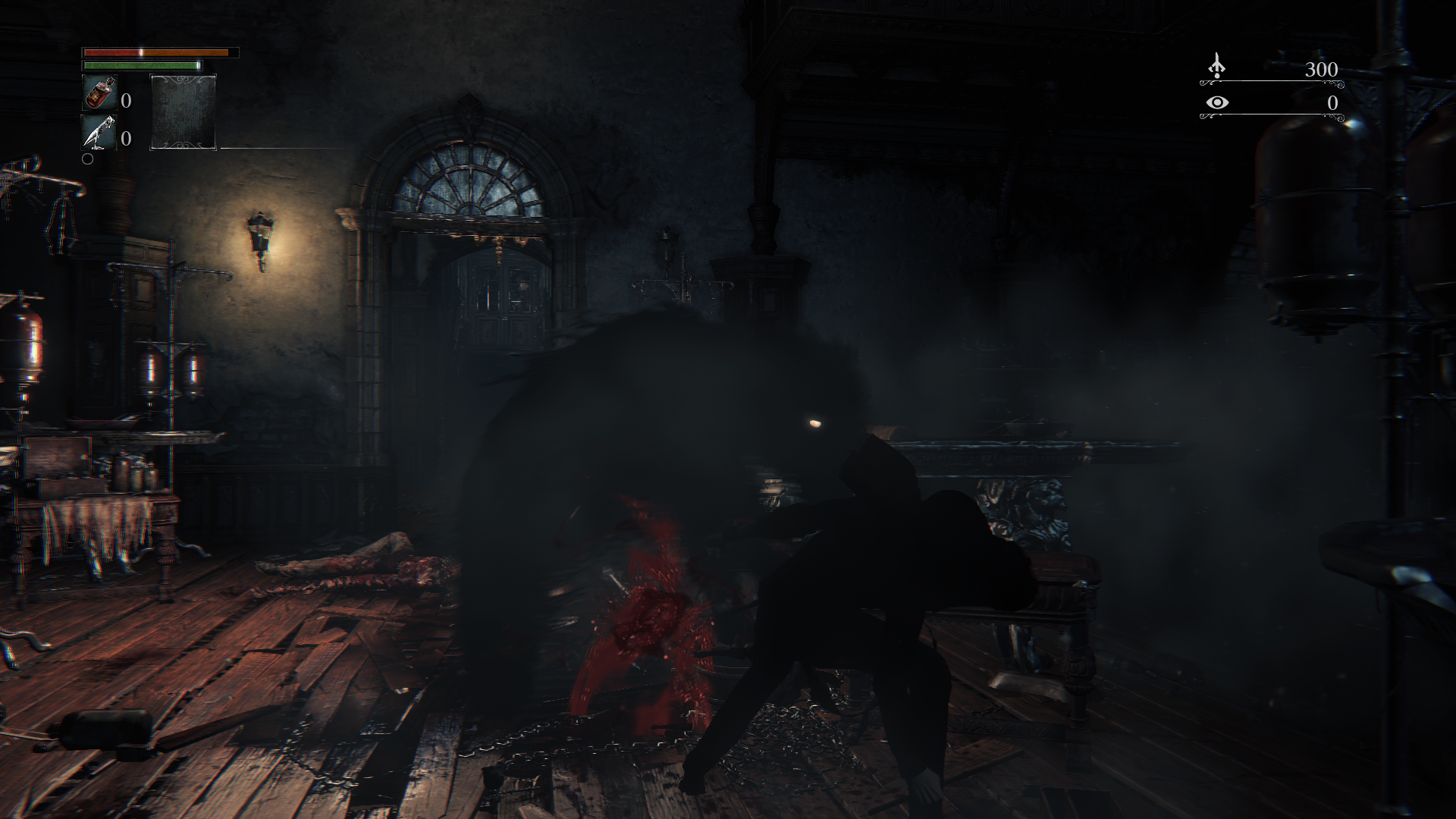
The Clinic Beast is the first enemy a new hunter meets. It crouches over a body in the lower hall of Iosefka's Clinic and keeps feeding until it notices you, then rises and attacks. In Paleblood the whole meeting now plays out: its first attack lands, the hunter dies, and wakes in the Hunter's Dream.
This page explains exactly how it works, from Paleblood's decompiled and verified code and our own recorded runs. Each section starts with a sentence or two in plain words, then gives the precise rules. Small labels say how sure we are of each rule; the last section explains them. We call it the clinic beast because everything below was measured in this one encounter.
Where you find it
It feeds on a body beside an arched door, in the hall below the operating room where a new hunter wakes. You reach it by walking down the stairs. Our test runs start from a save inside the clinic and take that same route.
How it notices you
The beast has a nose, eyes and ears. Its nose works in every direction and through walls, but only up close. Its eyes reach further, but only in front of it and only with a clear view.
Every enemy in the game runs this same perception code; what differs is a handful of distances and
angles in each enemy's own settings (its think data, the NpcThinkParam table). This wiki
explains the rules, not the numbers in that table.
The nose
It smells you once you are close enough, whichever way it faces and whatever stands between you. confirmed in the game's code
The sight test ai_sight_test (0x016a52b0) checks the nose first. A character is smelled when
the distance between them is shorter than the enemy's nose distance plus the body sizes
(radii) of both characters. No angle is checked and no ray is cast, so walls do not block it.
In our runs the beast smelled the hunter at 3.48 m; the check before that, at 6.84 m, found nothing. So for this beast the nose reaches somewhere between those two distances. seen in our test runs
The eyes: the sight test
If the nose finds nothing, the eyes get their turn. You must be in a cone in front of it, not too close and not too far, with nothing solid in between. Every step below must pass. confirmed in the game's code
- How far it sees depends on the dark where you stand. Its settings hold three eye distances: for light, for dark and for pitch dark. The test picks one by how dark it is around the target, multiplies it by the target's visibility and the enemy's own sight scale, and adds both body sizes.
- The eyes sit behind its body. Distances are not measured from where it stands, but from a point moved back along its facing (the eye back offset). The tip of the cone is behind it.
- Blind up close. Closer than the begin distance (measured from that point behind it), the eyes see nothing. At that range only the nose can notice you.
- Width. Flatten its facing and the line to you onto the ground: the angle between them must be within the width angle. The setting stores half the cone, so the full cone is twice that.
- Height. The line to you must not climb or drop more steeply than the height angle.
- Line of sight. When the caller asks for it, a ray is cast through the physics world from its eye height to yours. If the ray hits anything, you are not seen. If no physics world is loaded, this step is skipped and you count as seen.
One override comes last: a target marked unseeable is never noticed. The test returns one of three answers: not noticed, smelled or seen. Paleblood's replacement of this test gives the original code's answer on 886 edge cases and on all 1,089 checks recorded in real runs of this encounter, and an independent review approved it (#997).
In none of our runs did its eyes see the hunter: every run came at it from behind. On the way down the stairs the hunter was about 120° off its facing, outside any forward cone. seen in our test runs
Hearing
It can hear sounds, but only those made by characters it is allowed to hear, and only within each sound's range; just beyond that, it hears in the direction its ear points. in the game's code, tested on examples only
The game files every sound with a position, a range (how far it carries) and who made it. An enemy checks each sound near it in two steps:
- May it hear this maker? The sound check
ai_hearing_check_sound(0x0169cef0) looks at who made the sound. A character's sound (the player's, another enemy's) counts only if that character still exists and the listener's team may hear the maker's team: the game keeps a table of which teams hear which. Some sounds use the attack tables instead, so exactly the teams an attack would hit can hear them. A big maker is heard from a little further away, because its body size is passed on. A sound made by an object counts while the object exists. - Is it close enough? The hearing test
ai_hearing_test(0x0169d160) takes the sound's range, less a sound-cut distance from the enemy's settings, and compares it with the gap between them: the distance less both body sizes. If the range is larger, the sound is heard. If not, the ear can still reach a little further, but only inside its own cone: a width angle around its facing and a height angle (checked by0x0169da30). A heard sound's position is remembered, unless the enemy already remembers a closer one.
Paleblood has replaced all three of these and checked them against the original on 1,642, 561 and 449 constructed cases (#1103, #1089, #1067), but not yet against recordings of a real run. Whether this beast hears you before it smells you is not known yet.
Why it gets up
It does not get up when you enter the room. It gets up once it has noticed you, most likely by smell. our reading of the code, not yet confirmed
Putting our runs together with the code, the likely chain is:
- its nose notices the hunter, who gets an entry on its target list (next section);
- its alert level climbs to battle;
- the area's event logic, which has kept it in its feeding loop since the area loaded, sees that level and plays the rising animation. In our reading, hitting it releases it too.
Step 1 is replaced, verified code plus recorded runs. Steps 2 and 3 come from our reading of code that is not in Paleblood yet: the routine that raises an entry's level, and the event logic. A simpler trigger such as "the hunter entered the room" does not fit our runs: in one, the hunter stood well inside the room for many frames, and the beast kept feeding until the hunter was about 3.6 m away. seen in our test runs
How it keeps track of you
Everything the beast has noticed goes on a list. From that list it works out how alarmed it is and who its main target is, again and again, rather than slowly getting angrier.
Four alert levels
Its scripts see one of four levels: normal, caution, find and battle. confirmed in the game's code
The script questions IsCautionState, IsFindState and IsBattleState test for levels 1, 2 and 3;
GetPrevTargetState returns the level from the previous think, and IsChangeState is true when the
two differ.
The level is not stored and nudged up. Each think, the perception update ai_perception_update
(0x016a85c0) works it out again from the target list, in a fixed order: two special kinds of
list entry mean battle; failing those, the main target's own level counts; failing that, two other
special kinds mean caution; an empty list means normal. What the special kinds stand for is not
known yet. The old level becomes the previous one, so IsChangeState is true for exactly one think
after a change. Paleblood's replacement gives the original's answer on 802 edge cases and on 1,493
calls recorded in this encounter (10 more recorded calls are set aside because the code they reach
could not be replayed), and an independent review approved it
(#1079).
confirmed in the game's code
The target list
The list holds characters it has noticed and places it means to go and look at.
- Sensing about once a second. The list update senses the world about once a second, plus a random extra of up to a fifth of a second, so many enemies do not all sense on the same frame. our reading of the code, not yet confirmed
- Forgetting. Each entry has a clock. When it runs out, the entry is marked not visible and the clock restarts from the enemy's sight forget time (counted in 30ths of a second). Remembered places get a fixed 20 seconds. our reading of the code, not yet confirmed
- Noticed again. When the sight test notices a character already on the list,
ai_target_list_refresh_noticed(0x016b2760) resets its clock, marks it visible and flags it as noticed this think. Anything new gets a fresh entry at the front of the list. confirmed in the game's code - Choosing the main target. The entry with the highest priority above −1 becomes the main
target; among equals, the first one wins.
ai_target_list_mark_main_matches(0x016b30a0) marks every other entry that stands for the same thing: the same character, or a place within half a metre. An entry that starts matching gets an eight-second recheck timer if its old one had run out. confirmed in the game's code - "Can it see its target?" The script question
IsVisibleTarget(0x0165ca50) does not look for itself: throughai_perception_target_visible(0x016ad400) it returns the visible flag the sensing left on the current target. our reading of the code, not yet confirmed (the lookup is verified; the script binding is replaced and tested on examples only) - How fast you are coming. Every frame
ai_target_speed_record_update(0x0162d840) records how fast its target approaches, keeps the last 30 samples and averages them with the newest weighted most. confirmed in the game's code What uses this speed is not traced yet.
How it fights
Once it has noticed you, it turns to face you and attacks. How it picks each attack comes from the game's own AI script: a dice roll weighted by how far away you are.
What our runs showed
seen in our test runs
- Before it notices you it runs the same idle plan as every other character in the clinic: a short plan it renews over and over.
- When the hunter came close it first switched to a separate "noticed" plan, and some seconds later started its own battle plan.
- With the hunter behind it, its battle plan's first decision was a one-second turn to face them.
- Its first attack is a lunge that lands with a spray of blood. Since 14 November Paleblood runs the rest without a stop: the hunter dies ("YOU DIED"), the loading screen shows, and the hunter wakes in the Hunter's Dream (Runtime).
- What its script looked at in our captured fight: random whole numbers (the dice below), timers and the target's alert level. It never checked its own health or the hunter's.
How it chooses its attacks
read from the game's script, not yet confirmed in a run This comes from a local study of the game's own AI script for this enemy, not from Paleblood running it; the native code that runs these plans (goals) is still being decompiled (#1109 is its first part). Only the turn when you are behind it has been seen in a run. No script text is published here.
- A weighted roll by distance. Each time its battle plan restarts, it gives every move a weight that depends on which distance band you are in, then rolls the dice over the total. Close up it favours its quick opening swings; at mid range, its two-hit lunge; far away it mostly circles or backs off (about four times in ten), and otherwise closes the gap with a leaping attack or a run-in.
- Follow-up chains. Most attacks start with one swing, then roll again to decide how many follow-ups to chain, up to four hits. It keeps turning towards you during the wind-up of most swings. One long flurry mixes back and side hops into the chain.
- Cooldown and space. One heavy move has a cooldown of about twenty seconds. In a few tight spots of the map it never uses its two widest moves.
- Breathers. After every attack it decides on the spot, from your distance, what to do next: very close, it usually hops back or backs off a few metres; at mid range it strafes or edges closer; far away it closes in or, about one time in three, leaps at you.
- Turning. If you are behind it, its next decision is just a turn to face you rather than an attack (seen once in a Paleblood run, above).
- Reactions. It can answer gunfire with a side hop, and it has the common stagger and dodge reactions many enemies share.
The dice themselves are confirmed. The script call GetRandam_Int (0x01657b20) turns a 20-bit
random fraction into a whole number from min to max, each about equally likely. The beast's script
called it 35 times in our captured fight.
confirmed in the game's code
Tips
Each tip follows from a rule above; the label says how solid that rule is.
- You cannot sneak right up to it. Its nose works in every direction, so it notices you a few metres away whichever side you come from: about 3.5 m in our runs. confirmed in the game's code
- A wall hides you from its eyes, not its nose. The line-of-sight ray stops at solid things; the nose check has no ray at all. confirmed in the game's code
- Hugging it does not hide you. Its eyes are blind up close, but its nose is not: in our runs it smelled the hunter at about 3.5 m. confirmed in the game's code seen in our test runs
- Coming from behind buys a moment. Its first decision in our run was a one-second turn, not an attack. seen in our test runs
- Expect more than one hit. Most of its swings can chain into follow-ups, up to four hits, and it keeps turning during the wind-up. read from the game's script, not yet confirmed in a run
- Mind the leap at range. Backing far away does not make it safe: from far off it often closes in, sometimes with a leap. read from the game's script, not yet confirmed in a run
Did you know?
- It waits for your scent. It keeps feeding while you walk around the room and only rises once you are a few metres away. seen in our test runs
- Its eyes are set behind its head. The sight cone is measured from a point behind its body, so the tip of the cone sits behind it. confirmed in the game's code
- Darkness is judged where you stand, not where it stands. The sight range is picked from the light around the target. confirmed in the game's code
- It does not slowly get angrier. Its alert level is worked out afresh every think from what is on its list, so it can change in a single step. confirmed in the game's code
- Its ear is a little wider than intended. The direction to a sound is divided by the gap between the bodies rather than the true distance, which widens the ear's cone slightly. in the game's code, tested on examples only
- …and a little higher. For a sound just outside the ear's cone, the point on the cone's edge it is checked against gets its height by adding the sound's height to the ear's, so that point sits higher than the sound. in the game's code, tested on examples only
- Big characters are louder. A large maker is heard from slightly further away, because its body size counts towards the gap. in the game's code, tested on examples only
What we don't know yet
- Hearing in a real run. No recording shows yet whether it hears you before it smells you.
- How the level climbs. The routine that raises an entry from caution to find to battle
(
0x016b17c0) has not been read. - The wake trigger. Confirming why it gets up needs the event logic in Paleblood and a run that records the nose result and the event's reaction on the same frames.
- Its attack choice in a run. The weighted roll, chains and breathers come from its script; a longer recorded fight is needed to confirm them.
- Its identity in the game's data. Which of the game's character types this beast is has not been established in Paleblood source yet.
For the curious: how we know this
What the labels mean.
- Confirmed in the game's code (verified): Paleblood has replaced the original code with
readable C++, it gives the same answers as the original on edge cases and on calls recorded in
real runs, and an independent review approved it (
symbols/reviews.csv). - In the game's code, tested on examples only (edge-verified): replaced and checked against the original on constructed cases, not yet on recordings.
- Seen in our test runs (observed): watched or recorded in a Paleblood run of this encounter.
- Our reading of the code, not yet confirmed (inferred): read from code that Paleblood still runs as the original, or pieced together from several findings.
- Read from the game's script, not yet confirmed in a run: a local study of the game's own AI script for this enemy. No script text is published.
The AI system page describes the shared machinery these functions belong
to. All the Paleblood pull requests below are by ThisIsAkill. Status is as of Paleblood
5fba104352d8093dfc64bf346a97681ad554afea (symbols/functions.csv, symbols/verification.csv).
| Function | Status | Checks | Pull requests |
|---|---|---|---|
ai_sight_test0x016a52b0 |
verified | recorded 1089/1089, edge 886/886 | #958, #997 |
ai_sight_query_reset_target0x016a5a50 |
edge-verified | edge 4/4 | #958 |
ai_target_list_refresh_noticed0x016b2760 |
verified | recorded 6/6, edge 103/103 | #958, #997 |
ai_perception_update0x016a85c0 |
verified | recorded 1493/1503 (10 quarantined), edge 802/802 | #999, #1079 |
ai_perception_current_handle0x016acfa0 |
verified | recorded 3001/3001, edge 145/145 | #999, #1006 |
ai_perception_target_visible0x016ad400 |
verified | recorded 225/225, edge 109/109 | #936, #997 |
ai_func_is_visible_target0x0165ca50 |
edge-verified | edge 50/50 | #936 |
ai_target_list_mark_main_matches0x016b30a0 |
verified | recorded 47/47, edge 19/19 | #920, #951, #961 |
ai_target_speed_record_update0x0162d840 |
verified | recorded 426/426, edge 128/128 | #936, #981 |
ai_func_is_battle_state0x0165baf0 |
verified | recorded 6/6, edge 33/33 | #911, #988, #997 |
ai_func_is_caution_state0x0165bb30 |
verified | recorded 3/3, edge 33/33 | #911, #988, #997 |
ai_func_is_find_state0x0165bb50 |
verified | recorded 3/3, edge 33/33 | #911, #988, #997 |
ai_func_is_change_state0x0165bb10 |
verified | recorded 31/31, edge 33/33 | #911, #948, #997 |
ai_func_get_previous_target_state0x0165bb90 |
verified | recorded 9/9, edge 33/33 | #911, #988, #997 |
ai_func_get_random_int0x01657b20 |
verified | recorded 37/37, edge 73/73 | #911, #988 |
ai_hearing_check_sound0x0169cef0 |
edge-verified | edge 1642/1642 | #1103 |
ai_hearing_test0x0169d160 |
edge-verified | edge 561/561 | #1089 |
ai_hearing_in_ear_range0x0169da30 |
edge-verified | edge 449/449 | #1067 |
| Pictures and runs | Details | Evidence |
|---|---|---|
| Infobox picture | Local Paleblood run on 2026-11-13, main bb1d71b with #958 and #975 applied (both merged since); drawn by Paleblood's renderer at 1920×1080; its own media review |
observed |
| First-attack picture | Local Paleblood run on 2026-11-14, main 0ffc6fc with #1046 applied (merged since), frame 3880; drawn by Paleblood's renderer at 1920×1080; its own media review |
observed |
| Plans and script calls in the fight | Recorded Paleblood capture runs on 2026-11-14 that saved the beast's plan changes and its script's calls | observed |
| Approach and sight results | A recorded Paleblood capture run on 2026-11-13, saving every sight check | observed |
| Feeding at 4.0 m, turning at about 3.6 m | An earlier local run on 2026-11-13, watched frame by frame | observed |
| Attack choice, chains, breathers, reactions | A local study of the game's own AI script for this enemy; no script text is published | read from the game's script, not yet confirmed in a run |
Every claim in this section is labelled by the kind of evidence behind it.
| Label | Meaning |
|---|---|
| observed | Seen during play or in a recording, with its context: starting state, player position and actions, the visible change, and whether it repeats. |
| inferred | A conclusion drawn from code or tests, stated with the scope that evidence covers. |
| unknown | Not yet traced. It stays an open question, with the evidence needed next. |
- Observation is not implementation. An animation, health-bar change, phase transition, hit reaction, movement, or line of dialogue can be observed. On its own it does not identify an entity ID, function, data field, condition, timer, probability, script, or internal state.
- No guessing. Nothing is filled in from genre convention, a gameplay impression, animation timing, or a displayed bar. Visually similar actions are not assumed to share code. No guessed names, IDs, catalogs, or numerical tables are published.
- What a source claim needs. The entity, the function and address, the data or state it reads, the result it produces, public Paleblood source at the exact merged revision, tests, and independent review.
- Evidence kinds differ. Recorded original-game behavior, static analysis, synthetic Paleblood tests, and verified replacements are different kinds of evidence. A link to one does not prove the others.
- Tests have a scope. Passing tests support equivalence on the cases they cover, not untested gameplay situations. Timing and probability claims need measurements or directly verified logic, not a single encounter.
- Shared systems are not specific actors. Code that every enemy runs does not, on its own, say what one enemy does. An enemy page ties shared code to one actor only through a recorded run of that encounter, and says so.
- Absence is not a claim about the game. A missing profile describes the project's research, not what the game contains.
See Evidence & Media Review for how this wiki labels evidence.